Monday, December 19, 2016

Havana Day the first full day December 8, 2016. 

Some have asked about the difference between Lindblad/Nat Geo as compared to other experiences. One thing for me is the personal interaction with the Expedition Staff, so I have decided to copy and paste the Curriculum Vitae (CV) for some of our staff.  One of the first members we met and chatted with was Fabio while waiting for our luggage in Havana.  

Fabio Amador
National Geographic Staff

Fabio (Fe) Amador is a Senior Program Officer for the National Geographic Society/Waitt Grants Program, which is dedicated to funding exploratory research around the world. He has traveled and worked extensively throughout Latin America and is presently collaborating with research projects in Mexico's Yucatan Peninsula, Peru, El Salvador, and Madagascar. He has also traveled regularly to Cuba over the past five years on educational and scientific missions for National Geographic. As a trained archaeologist, his interest in Taino Indian culture (which spanned the Greater Antilles, including Cuba) is focused on the sacred landscape and the use of caves for ritual activity. In his role at National Geographic, Fabio uses imaging and visualization technologies to provide new ways of capturing data and to document the experience of conducting research and exploration. His initiative in supporting worldwide research has resulted in a workshop titled The Art of Communicating Science. This capacity building initiative is aimed at students, scholars, explorers, government agencies, and stewards of the cultural and natural patrimony, so that they can be trained in how to develop, design and use imaging technology to document, protect, and communicate the importance of their heritage through exploration, discovery, and storytelling. Fe's continued effort in communicating science has allowed him to use photography, cinematography, and other multimedia tools to reach large audiences through his public lectures at universities, presentations at international scientific and professional symposia, publications in scholarly journals and on National Geographicâs Explorers Journal and NatGeo News Watch online blogs.

WALKING TOUR of HAVANA 

This walking tour was only about 1.25 miles and we visited the various plazas as listed below.  

Plaza de La Catedral isla  symbol of Habana Vieja. Here we find the first Spanish aqueduct in the New World. The water was transported from the Almendares River about 7 miles away. 

Plaza de Vieja was laid out in 1559 and in the 1990’s it was restored to it’s original grander. This plaza was at one time the main public square. Here one can see the many examples of 17th Century architecture. Today there are many artist studios, shops, and restaurants in the arcades of this plaza. 

Plaza de San Francisco is where one finds the Fuente de los Liones. Here is located the old Customs House. Also located here is the Basilica Menor de San Francisco de Asis. This area was the home of the Franciscan Community.  

Plaza de Armas was our final plaza to visit this morning. One of the most interesting features of this Plaza is the wood paved street in front of the Paliacio de los Capiyanes Generales. The Generals wife did not like the sounds of the horses  hoofs on the cobblestones. So to soften the noise the street was paved with wood.  

During this walking tour we stopped at a local bar where they made Guarapo. Guarapo is fresh squeezed sugarcane juice, lime and rum if you choose. This was a tasty refreshing drink for a hot day. 


After the walking tour we had lunch at the private restaurant Casa Abel. Restaurants are either privately owned or Government owned. A private restaurant is allowed as they are taxed by the Government. The food here was excellent, there was a choice of chicken, fish, or shrimp. I chose the shrimp and Lynn had the chicken. The chicken was a half of a roasted chicken and the shrimp was prepared in a cream rice. EXCELLENT is all that needs to be said. There were also several appetizers presented, fried cheese, a shrimp salad, and a plate of plantain chips and fried casaba. I was too full for dessert of either flan or a lemon pie. Lynn had the flan ash it also was excellent. We were the given an aperitif of a 7 year aged rum and a cigar. I passed on the cigar. 

Finca La Vigia - Hemmingway’s Residence 

We then boarded our bus and headed to Finca La Vigia, ten miles east of Havana is Hemingway's Cuba house - Finca Vigia, meaning "lookout house”.

This was a highlight of the day for me as this was Hemingway’s residence when he was in Cuba. The rooms are closed off by a rope, yet photos can be taken. It is interesting that the restoration is basically maintaining the residence as Hemingway left it when he returned to the US in 1960. Many locals believe he planned on returning. So for me to see this residence as it was when he lived there made it very special. This location is where he wrote For Whom the Bell Tolls and The Old Man and the Sea. Here one can see his pet cemetery and, of course, the Pilar. The Pilar was his fishing boat, and its current state is very well maintained. Just to see the fighting chair on this boat was very meaningful to me. During WWII Hemingway used the Pilar to patrol the waters off of northern Cuba searching for German U-Boats. The whole property is about 15 acres and there is a guest house and garage which is not open to the public. There is also a tower there where he would go to write and look out over the countryside at Havana. The guard of the tower thought I looked like Hemingway and was kind enough to allow some special pictures to be taken.  The whole residence is owned and operated by the Government.   

From the residence. we made our way to Cojimar, the fishing village purported to be the inspiration for The Old Man and The Sea.  We did visit Hemingway’s favorite local bar for a beverage. This is the La Terrraza de Cojimar, where Hemingway’s favorite table is set and awaiting his return. 

We then made our way back to the Hotel and had some free time before dinner. We used this time to catchup on logs and photos.

Before dinner we had a guest speaker who was an older gentleman and an architect. He spoke to us about the architecture of Havana and most interesting to me were several points he presented. First Cuba and Havana is a melting pot, many different cultures roots can be found here and yes they have influenced the architecture and further the culture of Cuba. While change is happening in Cuba he feels it will take many years as peoples minds and lifestyles will not be changed over night. The people of Cuba are used to the government providing everything they need, food. clothes, medical, housing. There are no homeless people in Cuba. We observed many many buildings in a states of disrepair and abandonment. The condition of the property is due to the lack of resources to repair and maintain these building. I see many properties which could be very very nice with a lot of TLC,    


 Dinner this evening was at one of the hotel restaurants which is located in the gardens. Here the meal is served family style and the seating is on long tables, each seating about 14 persons. The menu was Shredded beef in a tomato sauce, roast pork, baked squash, rice and beans, All items were great and for dessert there was flan and coffee. 


FYI: The coffee is nice and strong and do not even think about asking for decaf, and Sugar is King and if you want sugar substitute you better bring  it because Sugar is KING and they are proud of their sugar. 

Yes, one of these days more photos will be posted at http://soggymoosephoto.smugmug.com


Guarapo is fresh squeezed sugarcane juice, lime and rum if you choose. This was a tasty refreshing drink for a hot day. 


Wooden paved street. 


Ration store, the board show the prices. These are in Cuban Pesos with a value of 25 CUP to one USD. 


Finca La Vigia - Hemmingway’s Residence 


The lady guarding this room saw me alone and called me Hemingway and let my camera capture these pictures from behind the rope. Special moment for sure. 


Words were forged into great novels on this typewriter.


Many a Marlin and other fish were landed from that chair.


The harbor where the Pilar was mored, and from which many people launched their sea journey to Florida. 


Sunday, December 18, 2016

Miami to Havana

Miami to Havana: 

We arrived late into Miami and after getting our bags we made our way to the Airport Hotel for a quick 6 hours of attempted sleep. 

We did get up before our 0600 alarm and got together and headed to our meeting point. As we we were walking to the meeting location, we were stopped and learned the location had changed. Here we started the checkin process. We received three copies of a document we signed and received our visa’s. Then we checked our bags and received our boarding passes. Then off to security which went pretty quickly even though we did not have pre check. 

We found our way to the Centurion Lounge and had a bit of breakfast and then off to our gate, to await our flight. 

This will be an exercise in lines and waiting, no biggie. 

The flight was about 45 minutes and we landed in Cuba at Jose Martin Airport. During the flight you will receive a customs form and a health form, there was another form but they ran out so we did not fill that one out. Here, your first stop is Passport Control where 1/2 of your visa is collected. FYI, if flying into Cuba one needs to keep your boarding pass, as it is proof you have Cuban medical insurance.  Next you stop at the wooden desk manned by nurses and drop off your health form. Next is baggage claim, this is a very very slow baggage service and we were lucky as ours came right out, and that is relative. Next is customs where you drop off your customs form and they check you bag tags. One is simply  asked if you are carrying any prohibited items. Next we gather and are escorted to a bus where 21 of us are seated and we take off for a drive to Havana and we made a stop at a memorial where there is a large statue of Christ. This is located on the east side of the entrance to Havana Harbor. Here one also passes a display of Soviet artillery, armored vehicle, a MIG jet and parts of a US aircraft which was shot down. 


From there we made our way to our restaurant for lunch, La Divina Pastora, where we were greeted with a Cuba Libre. We were seated in an outdoor area and enjoyed a cream of spinach soup, followed by a broiled lobster tail served with veggies and rice, with a garlic butter. IT WAS EXCELLENT. Dessert was chocolate ice-cream with caramel sauce and Cuban Coffee. 

This restaurant is located at a cannon emplacement where several cannons overlook the entrance to Havana Harbor. We see geckos, mockingbirds, brown pelicans, and turkey vultures. 

After lunch, we drive about town and end up at a dance studio where we enjoy a private performance. The group is called Habana Compas Dance and their style is a fusion of African and Spanish styles as this is where these cultures melted together. 

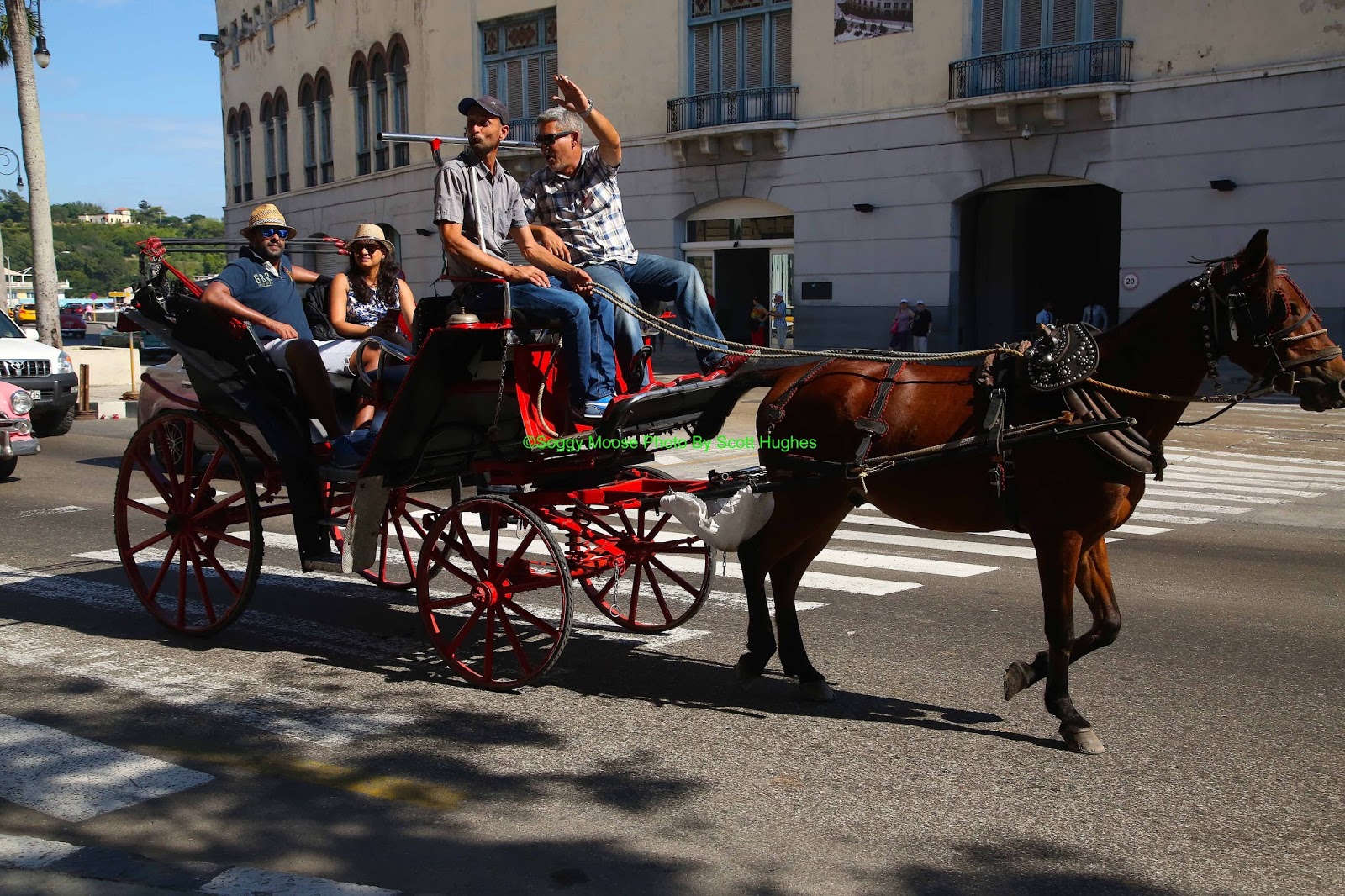
One hears about the old US cars in Cuba, well, they are everywhere. They are quite valuable, costing locals up to $50,000 CUC ($50,000 US). Yet the owners do not want to sell them as they can make very good money using the vehicles as a taxi. I would say most of the vehicles we saw were mid 1950’s and were all makes and models. Our local guide, Elio said the people who work on these cars are magicians as they need to manufacture the tools to do the repairs. They consider the new cars Toy Cars as there is no skill involved in keeping them running. 

After the dance studio, we made our way back to the Hotel Nacional and checked in and got settled into our room. We are on the 6th floor with executive room privileges. This hotel harkens one back to the early 1930’s in architecture and ambiance. 

At 1915 hours we meet in the lobby and are placed in the 1950’s cars for a drive about town. Our driver, Rolando, has several old cars and we are in his 1956 Chevy Belair. The car is amazing wonderful. The drive train is a Mercedes engine and transmission and the interior is immaculate. The name of this car is Diamond.  He also has a 1932 Packard. We chatted a good deal about his car.  Rolando has family in the United States and he can go there for visits, but his wife who is a doctor, is not allowed to visit the USA. 

We made a stop at Revolutionary Square for photos before we made our way to the restaurant, La Moneda Cubana.   Again we had an amazing meal with several choices from lobster to fish to beef to pork. Lynn chose the marlin and I had the beef. Both dishes were amazing. We did hear the 2100 cannon shot. Every evening from the fortress which guards Havana Harbor, the cannon is fired at 2100hrs to call an end to the day. 

After dinner we returned to the hotel where we called it a night. 

My first general thoughts for this day:
  1. Buildings are either well maintained or they are in all states of decay. 
  2. Old cars are everywhere, so many more than I expected. 
  3. People are happy and very friendly. 
  4. Education and healthcare are free.
  5. The average monthly income is about $25 to $40 CUC or $25 to $40 dollars. 
  6. Health care here is excellent, as there are many doctors, Cuban doctors also serve missions in 89 different countries. 
  7. We are tired and need some sleep after we do some laundry.  


Breakfast is at 0700 and our walking tour starts at 0900, I might try and catch the sunrise. 

Once all photos are reviewed many will be posted to http://soggymoosephoto.smugmug.com


Friday, December 2, 2016

A visit to Cuba with Lindblad National Geographic Expeditions

CUBA with Lindblad National Geographic Expeditions 


Ceilin' fan stirs the air
Cigar smoke did swirl,

Sailin' on a midnight boat,
There were no questions asked,
Water's so green and the air was so clean
That he stuck right to his task, Havana daydreamin',
Oh he's just schemin', his life away. 


I was 10 - 11 years old during the Cuban Missile Crisis and remember having drills in school where we would dive under our desks and cover our heads. Later in life I would meet and get to know a few people who fled Cuba during the revolution, their stories always intrigued me. Hearing stories of the boat people and their desperate efforts to sail to Florida on make shift vessels. As a Deputy Sheriff in Wyoming having to deal with a couple of individuals from the Mariel Boat Life. I later had a chance to chat with a Navy Veteran who was a radio operator who listened as the Bay of Pigs invasion took place.  I had read stories of the pristine diving in Cuban Waters, and the old US vehicles and the ingenuity in keeping them running for many years. Then there was the reading of Hemingway’s “Old Man and the Sea” and knowing of his time in Cuba. A fascination with Cuba has always existed. 

 With the easing of restrictions on US citizens traveling to Cuba this vail of mystique has been lifted. A few friends have recently traveled to Cuba and we have been encouraged to get there as I say before there is a Starbucks on every corner. This trip came together rather quickly, compared to how we normally plan. 

The November 2016 issue of National Geographic has a very interesting article about the first US cruise ship arriving in Havana. The key thoughts I took away were the Cuban People while welcoming the Tsunami of US tourist there is a feeling things will change in time. The article talks of the verb “resolver” meaning to manage with creative dexterity the challenges of modern Cuba, with improvisando as you go.  I sense there is a great respect for the natural wonders of Cuba, with a desire to protect these treasures. 

We will be traveling with Lindblad/National Geographic Expeditions on their first visit as a people to people visit. Having traveled with Lindblad/ Nat Geo before we know we will have an in-depth experience as we explore the cultural , the natural history, and the endemic bird and plant life. We will start our expedition in Havana with a three night stay at The Nacional a Havana Landmark. Not 5 star but what a classic institution of Cuban History, the playground of the rich and famous and “The Mob” during the 1930’s and 1940’s. 

After three days in Havana we travel to the South side of the Island to Cienfuegos where we board the Sailing Vessel Panorama II. The next seven (7) days we will sail to the Bay of Pigs, Cayo Largo, Trinidad, and the Jardines de la Reina (Gardens of the Queen). 

We enjoy traveling with Lindblad/ Nat Geo for the depth of the experience they offer. This will be their very first expedition to Cuba so we may have to roll a bit with the flow, but that can bring about some very unique experiences.  Yes these are expeditions as the itinerary is not set in stone and more of a suggestion.  Our group size will be no more than 44 fellow travelers.  At this time some plans are in flux due to the slow permitting system. Roll with the Flow will be the theme, but that is a good thing. 

As internet connections may be rather limited and slow, I have no Idea as to when we will be able to post blog entries.  So, I hope you enjoy sharing this journey with us. 


More Photos will be posted to  http://soggymoosephoto.smugmug.com ,