Friday, March 9, 2018

AMAZING MARKETS AND HOLMES

Day 3 


Our morning started with breakfast and a plan which quickly changed. All that really changed was the sequence we decided to visit the mornings markets. 

We boarded the Jubilee Line to London Bridge Station where we transferred to the Northern Line traveling South to Elephant and Castle.  From the Underground station we walked down Walworth street to the East Street Market. 

As a side, note the name Elephant and Castle is derived from a knife makers guild’s who produced knifes in this area The Elephant and Castle were their trade mark. 


East Street Market is one of London's oldest, largest and busiest markets. There are a wide a variety of goods offered, from fresh fruit and vegetables to African clothing and materials.


There has been street trading in the Walworth area since the 16th Century, when farmers rested their livestock on Walworth Common before continuing to the city. 

East Street is also famous for being the Birth Place of Charlie Chaplin. 


We made our way back to the Elephant and Castle Underground and travelled to Bermondsey, where we alighted on foot to find the  Bermondsey market, sometimes called the New Caledonia Market. 


The Guinness Trust Buildings we passed the day before. 


Where were we not to attach bikes??


The Bermondsey Antique Market has a wide range of antiques. Here traders sell everything  from cutlery to furniture and china, books and jewelry and more. It is rather fun to meander about and window shop. I did find a Pie Bird which was not to be passed up. 


PIE BIRDS 


From the Bermondsey Market we walked back towards the London Bridge Underground station and to the Borough Market.  Thus far, this is the king of the foodies markets we have yet to experience, everything from fresh butchered meats, fresh produce, to pies, to pastries, to sandwiches, juices and wine.  The market is bustling and thriving, humming with activity. I believe it is a location where many chefs come to shop for their restaurants daily needs. 


Borough Market has existed in one form or another for around 1,000 years. 

Continuing on in celebration of National Pie Week we purchased a Cornish Pasty, meat and veg. Then a custard pastry for dessert. 

We  next ventured to the Embankment Underground Station. As we were rather early for The London Walks Sherlock Holmes Walk, we found refuge in the Princess of Wales Pub.  Soon it was time for the 1400 meet up and the rain decided to start falling. London Walks take place rain or shine. 

Oh Look a Cabbie Shelter!!! Best Bacon Sandwiches in my book, price is up to 2 Pounds 


Our Guide was Richard the 4th, as he was the 4th guide named Richard hired by London Walks. 

Again London Walks did not disappoint. Sir Arthur Conan Doyle and his writings of the Sherlock Holmes stories were the featured theme.  Interestingly, the Holmes stories were penned over a 40 year period from 1886 to 1926.  Doyle was a medical doctor by trade but made a pretty penny as an author. As a doctor he did practice at the Charing Cross Hospital to which there are references made in some of the Holmes stories. As a doctor it seems fitting he and Watson shared the same profession. 

It seems the character of Watson was used to ground Holmes and serve as the normal to Holmes’ eccentricities. 

Interesting that it was the Strand Magazine which propelled Holmes into the limelight when the Sherlock Holmes  short stories were published. 

Many of the locations mentioned in the Holmes stories were fictional, yet oft based on similar location. One place not created by Doyle was Simpson’s Restaurant, which was mentioned by name in three different stories. 


A lot of Holmes physical characteristics were brought to life by Sydney Patchet, an illustrator for Strand Magazine. He is credited with giving Holmes the classic Dear Stalker Style Hat. The meerschaum pipe came into being as a prop for a Holmes stage play, as a nice large pipe was easy to see by the audience. 


We ended the walk here. With a visit up stairs to see the sitting room. 


We then passed through Covent Gardens Market and this Market is where Holmes and Watson came on the trail of the thief who stole the Countess of Morcar’s famed jewel the Blue Carbuncle from the Hotel Cosmopolitan. 


On this trip I have learned about Samuel Pepys  (1633-1703) who was an English naval administrator (With no Naval experience), Member of Parliament and Fellow of the ROYAL SOCIETY, but is now best remembered for the diary which he kept through the 1660s. It was first published in 1825, and has ever since been considered a unique historical source and human document.

“Strange to see how a good dinner and feasting reconciles everybody.”

So with a good meal in mind, we stopped at The Minories and had their fish and chips before making out way back to our hotel. 

Thank You Very much for reading and following along. 


Thursday, March 8, 2018

BERMONDSEY and LEADENHALL MARKET AND MORE PIE


PIE WEEK MARCH 5-11


After our breakfast we made our way to Bermondsey Station and met for a London Walks tour of Undiscovered London. This walk took us throughout Bermondsey and Southwark. 

London Walk offers many walks of various themes to cover many interests. The are lead by excellent  Blue Badge Guides. Here are some highlights of this walk.  

Bermondsey was a Socialist neighborhood and redeveloped to provide housing. The problem was they did not develop enough housing for those who were displaced.


Located along the Themes 


In this area Bryan Donkin acquired the patent for canning and preserving food in 1810. Strangely enough the can opener was not patented until 1855, prior to which a hammer and chisel and bandages were used on ones picnics. 


Being along the Thames this is an area of many warehouses. These overhead walkways were used to move the cargo from ships to warehouses further inland. 


The philanthropy of the Guinness Family stretched here to Bermondsey as they built this area of housing. 


The photo of the plaque explained this tunnel. 


During WWII Bermondsey and Southwark were heavily bombed. The residence pictured below was hit during one of the bombing raids and rebuilt with red brick rather than the yellow brick as a reminder it’s destruction and rebuilding. 


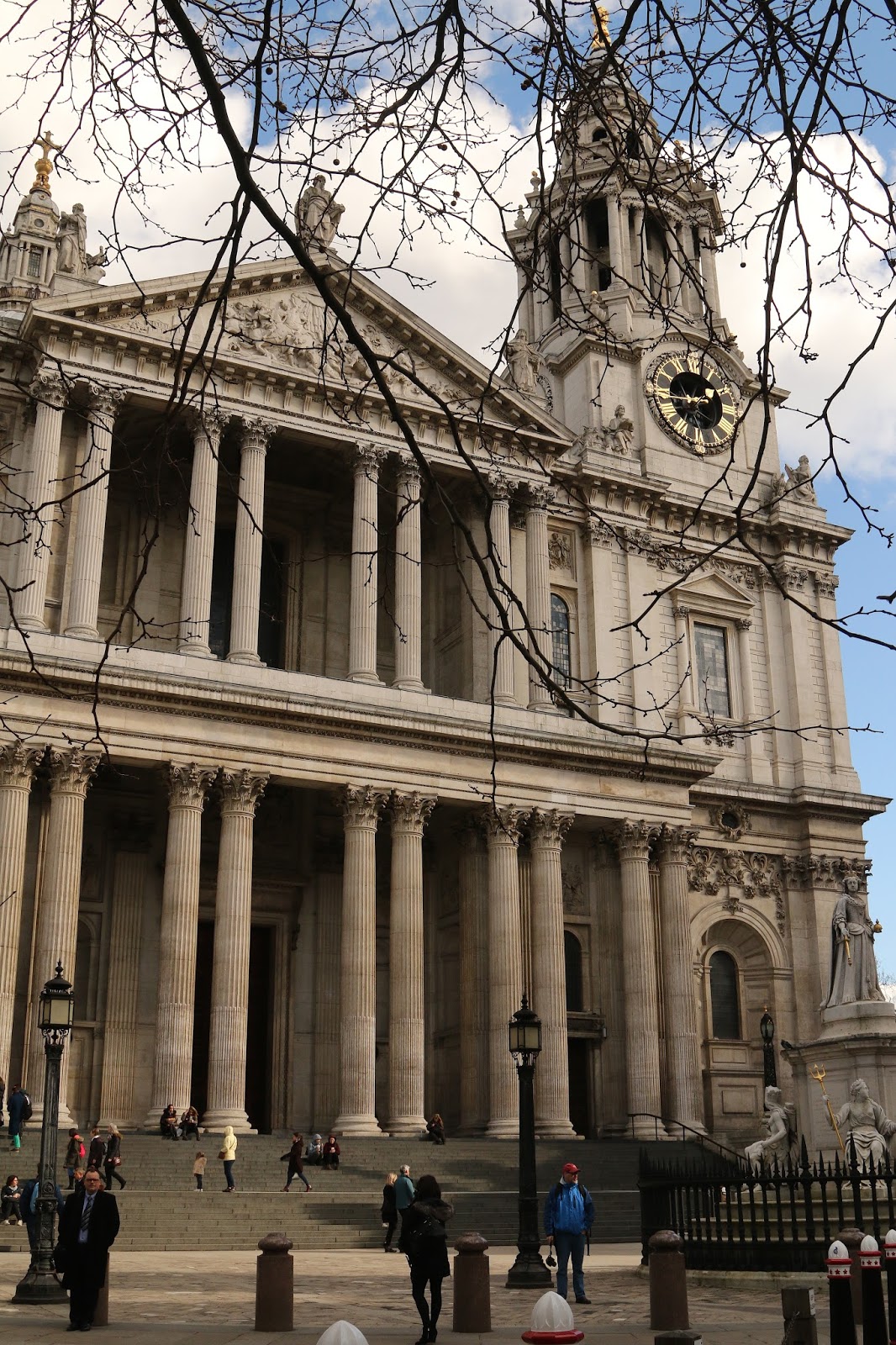
After this walk we were off to St Paul’s Cathedral to catch another walk. Sadly we became sidetracked and walked about on our own. 


St. Pauls is amazing to me as the resting place of Lord Nelson. 

I can not walk by these steps with out recalling the Mary Popping song Feed the Birds. 


Early each day to the steps of Saint Paul's
The little old bird woman comes
In her own special way to the people she calls
Come, buy my bags full of crumbs
Come feed the little birds, show them you care
And you'll be glad if you do
Their young ones are hungry
Their nests are so bare
All it takes is tuppence from you
Feed the birds, tuppence a bag,
Tuppence, tuppence, tuppence a bag
"Feed the birds, " that's what she cries
While overhead, her birds fill the skies
All around the cathedral the saints and apostles
Look down as she sells her wares.
Although you can't see it, you know they are smiling
Each time someone shows that he cares
Though her words are simple and few
Listen, listen, she's calling to you
"Feed the birds, tuppence a bag
Tuppence, tuppence, tuppence a bag


We found a coffee shop and decided to head to Leadenhall Market , as Lynn was looking for a hood for her Barbour Coat. 


The last meat shop in Leadenhall Market. 


Leadenhall Market dates back to the 14th century and is situated in what was the centre of Roman London. Originally a meat, poultry and game market, it is now home to a number of boutique retailers, restaurants, cafes, wine bars and an award-winning pub.
Starting as the site of a manor, Leadenhall has survived changes in use, rebuilding, and even the Great Fire to become a popular destination for city residents, visitors and workers.


In the 19th century the market was redeveloped by the architect Sir Horace Jones from its original stonework into the charming wrought iron and glass structure we know today. 


During this time, one of Leadenhall Market’s most popular residents appeared. This was Old Tom, a gander from Ostend in Belgium who is said to have arrived in the Capital having followed a female member of his flock who took his fancy! Despite the swift dispatch of the other 34,000 members of his party, somehow Tom miraculously managed to survive the dinner table and became a regular fixture at the market and the surrounding inns, who kept scraps aside for him.

Tom went on to live until the ripe old age of 37 when he died of natural causes and was buried on the market site. Pretty impressive for a gander living in such close proximity to a poultry stall, some might say very ‘plucky’ indeed!

So beloved was Old Tom that he even made it into the Times Newspaper! Below is his obituary, published on 16 April 1835:
In memory of Old Tom the Gander.

Obit 19th March, 1835, aetat, 37 years, 9 months, and 6 days.
‘This famous gander, while in stubble,
Fed freely, without care or trouble:
Grew fat with corn and sitting still,
And scarce could cross the barn-door sill:
And seldom waddled forth to cool
His belly in the neighboring pool.
Transplanted to another scene,
He stalk’d in state o’er Calais-green,
With full five hundred geese behind,
To his superior care consign’d,
Whom readily he would engage
To lead in march ten miles a-stage.
Thus a decoy he lived and died,
The chief of geese, the poulterer’s pride.’


From the market we walked to the area of London Tower for an obligatory tourist stop and photos. We did stop from some Cadbury Eggs and Chocolate. Yes these are way better than the Hershey's US Cadbury eggs in the states. 


We arrived at a favorite pub of ours, The Minories to have a pint and a pie. After all, it is National Pie Week here in London.


Then it was back to the hotel having gotten in 23000 steps for the day. 

Wednesday, March 7, 2018

Denver to London

DEN to London

Well Friends, this was a very last minute, very very good airfare deal, so here we are heading to London. Always something to explore and experience. Not sure of specific details for this trip but we may just explore markets, a bit o history (WW I and II, Egypt, and more), London Walks are always informative and it is National Pie Week in London. 

Our flight from Denver took us to Heathrow via Chicago. We were rather lucky as the flight was not crowded at all and were able to stretch out and sleep rather well, considering. Arrival went easy as we are traveling with just carry on luggage.  After clearing customs and passport control we made our way to the Underground and alighted towards London. Piccadilly line to the Jubilee line ending in Canning Town. Travel time I am guessing was about an hour. Our hotel is an Ibis Accor property - Ibis London Canning Town, and is located right across the street from the Underground and DLR station. One could not ask for a more convenient situation.  

We knew we would be arriving early and a room would not be available so,  we repacked and stored our bags and were soon headed to Greenwich, via the DLR,  to find the Greenwich Market. 


Food and crafts abound 


Well it is National Pie week, March 5-11


An Excellent Pie made a wonderful lunch


Do visit these folks for a great pie. 

Soggy Moose Travel receives no compensation for their recommendations. Just thought I would add the disclaimer, we pay our way. 


Steeped in Royal history, Greenwich has long been home to a Royal Charter Market which was originally assigned to the Commissioners of Greenwich Hospital on the 19th December 1700 for 1,000 years.

Originally housed on the site of the West Gate of the Old Royal Naval College, it began to spread into the neighboring area in the 1800’s and its dark streets and alleys were difficult and dangerous to control.

Three roofs were built to protect the market from the elements. In 1831 the market contained traders selling live and dead meat, fish, eggs, butter, poultry, fruit and vegetables. On its periphery lay peddlers selling goods such as china, glass and earthenware. Today you can still see some of the original slaughterhouses for cattle and stables for horses.

By the 1900's the timber roof was in a dangerous state of disrepair and was replaced by the current steel trussed and glazed roof in 1908, when the slaughterhouses were also closed. In 1905 the market bye-laws were changed to enable trading six days a week with the exemption of Sundays, Christmas day and bank holidays.

At the end of World War I horse traffic declined and the stables were used for storage. After World War II the wholesale fruit, veg, meat and fish stalls of Greenwich Market went through a gradual period of decline until the 1980s.

The 1980s saw a revival in the fortunes of Greenwich Market; the first arts and crafts market opened on 14th May 1985. Crafts and food can currently be found in the market, and some days antiques are featured in the booths.

The Food Booths offer a wide variety of ethnic foods from around the globe.  We saw food from Asia, South America, Europe and the Mid East to just name a few. Yet what caught my eye was Peatchey Pies, serving traditional English Pies.  The young man serving the pies was surprised I knew it was National Pie Week here in London from March 5-11. We chatted about pies and travel and ordered up a Steak and Ale Pie with mash for our lunch.  Yes we were a bit peckish, but I must say we both found the Pie to be excellent with very, very tender beef in a savory gravy. 


The pies are made with high quality ingredients and yes they are each hand made.  So if you should be visiting London, and are desiring a great pie, Find Peathchey Pies and you will not be disappointed.  


This courtyard pays tribute to Lord Nelson. Often overlooked it is worth a minute of ones time. 


Royal Observatory


Entry to the Painted Hall, 


Much is symbolized in this painting at the front of the Painted Hal. A tribute to the Royalty, the success and bounty of England, death in trade, peace, strength and more can be found in this work. 


Scaffolding for the Conservation 


Having visited this great hall in the past I never imagined I would have the opportunity to see this work so close.


A tribute to a British astronomer is dated April 22, 1727. This date coincides with a solar eclipse predicted before the completion of the ceiling.  


Portraits one of the last retired seamen to live on the grounds.


We then made our way to The Painted Hall  at The Old  Royal Naval College. The ceiling and walls were conceived and created by Sir James Thornhill,  and the building was designed by none other than Christopher Wren.    It took from 1707 to 1726 to complete. This was at a time when England was coming to power in the World.  The hall was initially used as a dining hall for the retired British seamen.                                                

Currently  this amazing Baroque art, which covers 10,000 square feet, is being refurbished. To assist in the restoration project, guided tours are offered  at a cost of 10 pounds, to assist  in this endeavor. The tour lasts just a bit over an hour. The amazing element of the tours is one gets to climb the scaffolding to observe the art work up very close and personal.   The working platform has been built 7 feet below the ceiling, so you are very, very up close and personal.  There are many hidden tidbits as past restoration workers left notes as they signed the ceiling. 

The Painted hall is also very special as it was here Lord Nelson laid  before being taken to St Paul’s for his final resting spot in St Paul’s Cathedral. 

These tours are being offered through the summer of 2018 and should not be missed. One will never have the opportunity during our lifetime to observed the ceiling in such  fashion.  So much history I can simply not relate it all and I assuredly have more to learn about this hall.  A plus to learn more are the notes of Sir John Thornhill explaining his masterpiece. 

We were feeling rather tired and headed back to our hotel to settle in and make plans for the week if we can stay awake. 


Cutty Sark’s  figurehead  Nannie Dee who chases Tam o’ Shanter, snatching his horse's tail before he escapes by crossing water.